Have you ever received a message where someone just typed “id” and you paused for a moment, wondering what they meant? Maybe it was a friend texting, “id love to come!” — and you thought, “Wait… what does ID have to do with love?” You’re not alone!
The truth is, “id” in text has nothing to do with identification cards or IDs. It’s actually short for “I’d,” which means “I would” or “I had,” depending on the context.
People use it all the time in casual texting because it’s quicker and fits the relaxed, unpunctuated style of digital chats.
Quick Answer:
“ID” (or more correctly, “id”) means “I’d” — short for “I would” or “I had.” It’s a friendly and casual way to write when texting or chatting online.
🧠 What Does “ID” Mean in Text?
In online conversations or messages, “id” is simply a typed shortcut for “I’d.” The apostrophe is usually dropped because people type fast or don’t care about punctuation in casual messages.
When someone writes “id,” they usually mean either:
- I would → expressing a choice, wish, or possibility
- I had → referring to something in the past
It’s all about context.
Examples:
- “id go if i wasn’t busy” → I would go if I wasn’t busy.
- “id already eaten before the call” → I had already eaten before the call.
So, if you see “id” in lowercase, it’s just a quick, informal way to write “I’d.”
💡 In short:
id = I’d = I would / I had (depending on the sentence).

📱 Where Is “ID” Commonly Used?
You’ll spot “id” in nearly every corner of the internet where people talk casually. It’s part of everyday online language — where grammar takes a backseat and convenience wins.
Here’s where it’s most common 👇
- 💬 Text Messages — quick conversations with friends and family.
Example: “id love that idea 😍” - 📸 Snapchat DMs — people drop punctuation for speed.
Example: “id totally snap u back lol” - 🎵 TikTok Comments — emotional or funny reactions.
Example: “id cry if my bf did that 😭” - 🐦 X (Twitter) — for expressing opinions casually.
Example: “id watch this movie 100 times.” - 🎮 Gaming Chats — for quick responses in fast-paced games.
Example: “id join ur team next match.”
👉 It’s casual and social-media–friendly, not meant for serious or professional use.
You can think of “id” as part of texting culture — fast, relaxed, and expressive.

💬 Examples of “ID” in Conversation
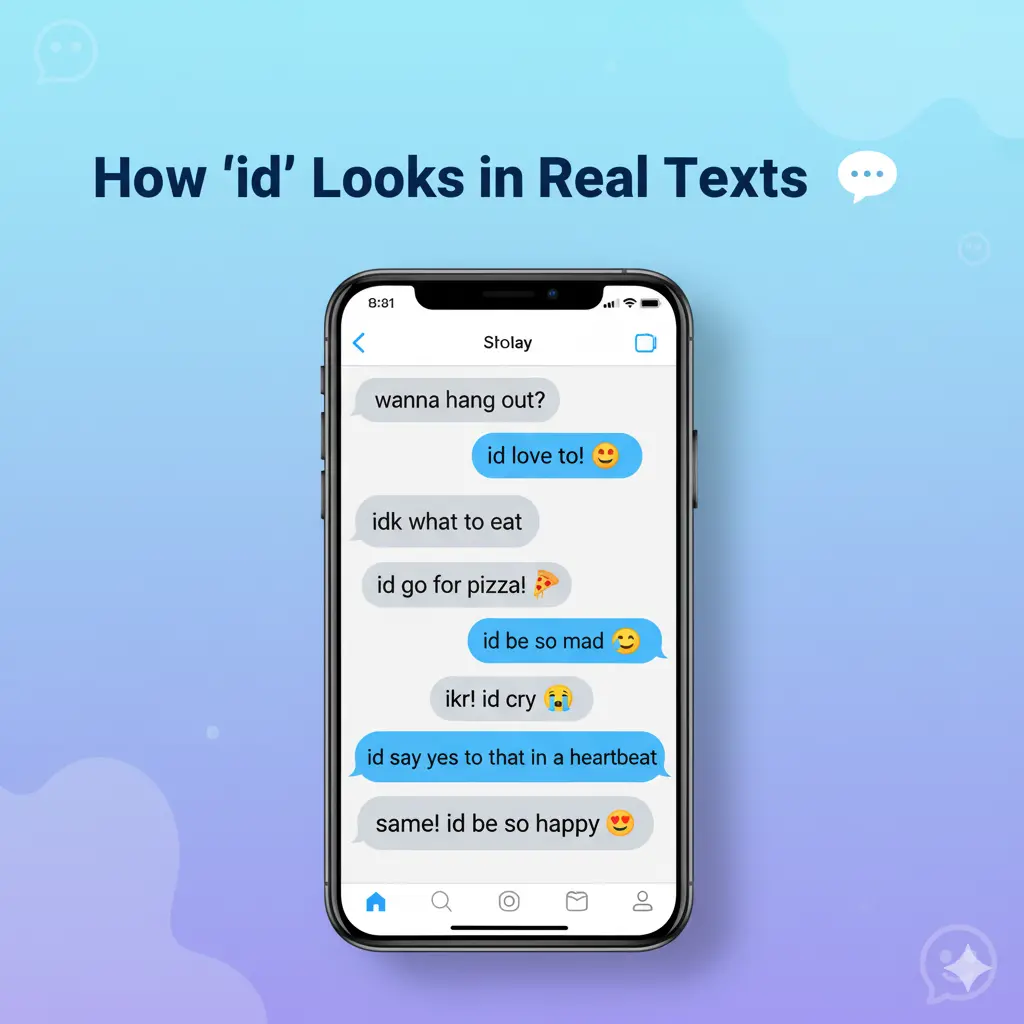
Seeing real-life chat examples helps you understand exactly how “id” is used in context. Check these out 👇
- A: wanna hang out later?
B: id love to but gotta study 😭 - A: what would u do if u met your favorite celeb?
B: id literally faint 😂 - A: do u think we’ll win the game?
B: id say 50/50 chance tbh 🎮 - A: if you had one wish?
B: id wish for endless tacos 🌮 - A: he didn’t text back yet 😕
B: id wait a bit more before replying. - A: wanna go on a road trip?
B: id pack my bags right now 🚗 - A: idk if i should message her first.
B: id go for it bro, nothing to lose 💪 - A: if it rains tomorrow?
B: id just stay in and binge netflix 😌
Notice how natural and fluid “id” feels in these examples? It’s quick, expressive, and fits the tone of friendly texting.
🕓 When to Use and When Not to Use “ID”
Like most slang or casual abbreviations, “id” has its place — and that place is not your boss’s inbox 😅
Here’s when to use it vs. when to skip it:
✅ When to Use “ID”
- When chatting casually with friends or close contacts.
- When commenting on social media posts.
- When sending quick texts where grammar doesn’t matter much.
- When joking or reacting informally.
- In captions, memes, or casual blog comments.
❌ When Not to Use “ID”
- In professional or academic writing.
- In work-related messages or emails.
- When clarity matters (someone might confuse it with “ID card”).
- In official documentation or reports.
Comparison Table
| Context | Example Phrase | Why It Works / Doesn’t |
|---|---|---|
| Friend Chat | “id be down for that 😄” | Casual & friendly |
| Work Chat | “I’d be happy to assist.” | Polite & professional (use apostrophe) |
| “I’d like to request feedback.” | Proper grammar & tone | |
| Social Media | “id cry if someone did this 😭” | Fits casual online expression |
| Academic Essay | “I’d argue that…” | Formal, grammatically correct usage |
As a rule of thumb:
👉 “id” = fast, informal typing.
👉 “I’d” = grammatically correct and appropriate everywhere.

🔄 Similar Slang Words or Alternatives
| Slang | Meaning | When to Use |
|---|---|---|
| idk | I don’t know | When you’re unsure or casual chatting |
| imo | In my opinion | Sharing opinions online |
| brb | Be right back | During live chats or gaming sessions |
| ttyl | Talk to you later | Signing off a casual conversation |
| wanna | Want to | Informal texting with friends |
| gonna | Going to | Expressing intent casually |
| lol | Laughing out loud | Reacting humorously in any light context |
These terms all share a similar relaxed tone — perfect for casual texting and friendly social interactions.
❓ FAQs About “ID”
Q1: Does “id” always mean “I would”?
No — it can also mean “I had,” depending on the context.
Example:
- “id already eaten” → I had already eaten.
- “id go if i could” → I would go if I could.
Q2: Is writing “id” wrong grammar-wise?
Technically, yes — it’s missing the apostrophe (“I’d”). But in texting culture, dropping punctuation is normal and acceptable informally.
Q3: Can “ID” mean something else?
Yes — in uppercase, “ID” stands for “identification” or “identity card.”
Example: “Please show your ID at the airport.”
So, lowercase “id” = I’d.
Uppercase “ID” = identification.
Q4: Is “id” flirty?
It can be! Context decides everything.
- “id kiss u rn 😘” → flirty.
- “id probably go there later” → casual and neutral.
Q5: How can I tell the difference between “id” and “ID”?
Pay attention to capitalization and tone.
- Lowercase “id” → casual, means I’d.
- Uppercase “ID” → formal, means identity card.
Q6: Is “id” used globally?
Yes! It’s popular among Gen Z and Millennials worldwide, especially in online communities, chats, and social media spaces where English slang thrives.
💭 Final Thoughts
Language keeps evolving, and texting slang like “id” proves how creative and fast-paced online communication has become. What started as a simple contraction — “I’d” — has turned into a quick, universal shorthand for expressing feelings, ideas, and reactions instantly.
Whether it means “I would” or “I had,” the key to understanding “id” lies in the context. It’s casual, expressive, and perfectly suited for modern conversations where speed matters more than grammar.
So next time someone texts, “id totally do that,” you won’t be confused — you’ll know exactly what they mean! Just remember to keep it lowercase for chats and use the proper “I’d” in formal writing.
👉 In short: “id” keeps texting friendly, fast, and real — just how digital conversations were meant to be.

I’m Sara Lexicon, a writer fascinated by words, slang, and how language evolves online. I love turning confusing phrases and trending terms into easy, fun explanations. My goal is to help readers understand and enjoy the language of the digital world. When I’m not decoding words, I’m exploring social media and discovering new ways people express themselves. I’m here to make modern language simple, relatable, and entertaining!