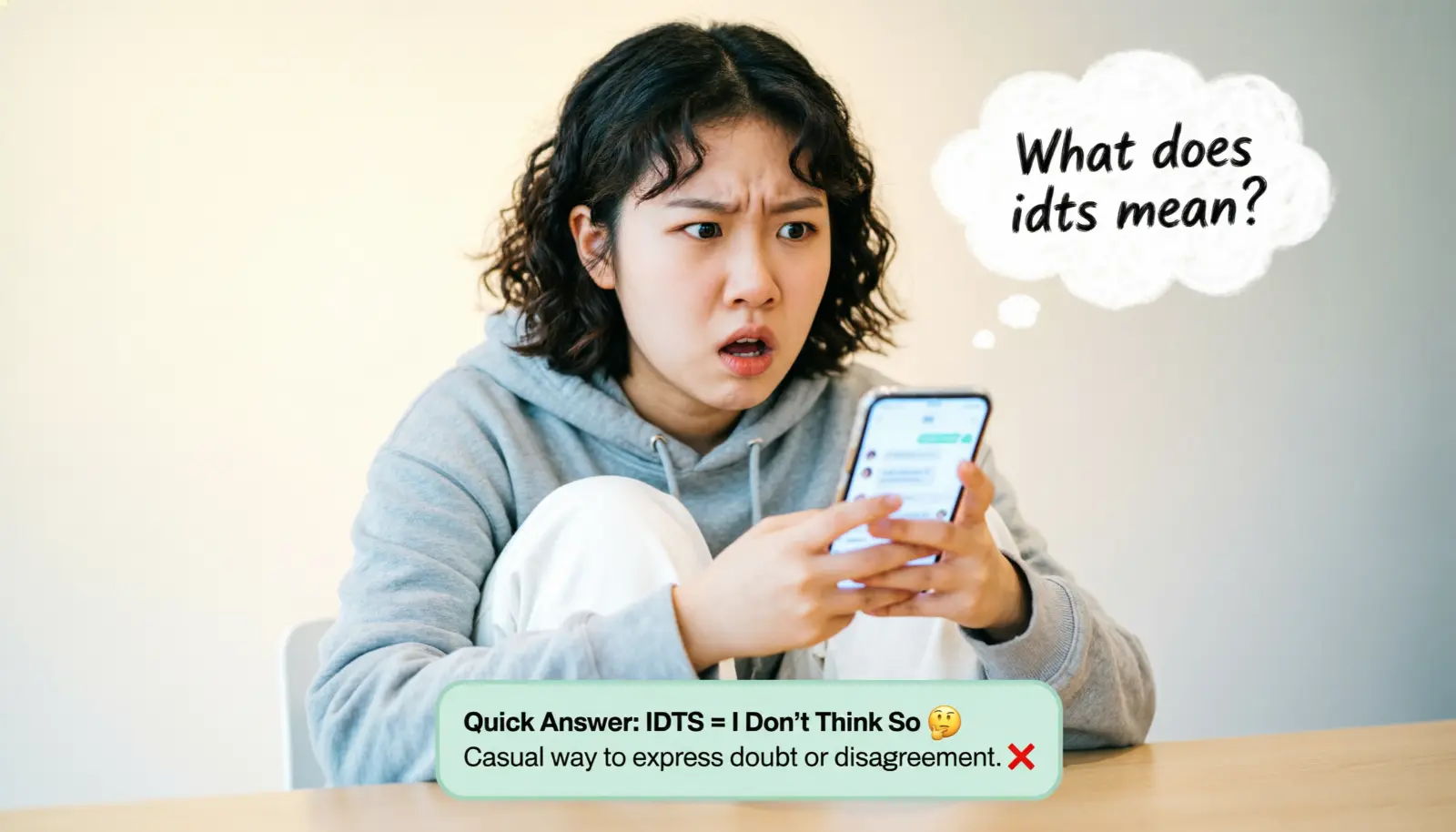
The first time I saw “idts” in a message, I honestly thought it was a typing mistake. The sentence made sense, but that short word confused me.
If you’ve ever paused mid-chat trying to decode modern slang, you’re not alone. Texting language keeps evolving, and abbreviations like this appear everywhere.
Quick Answer:
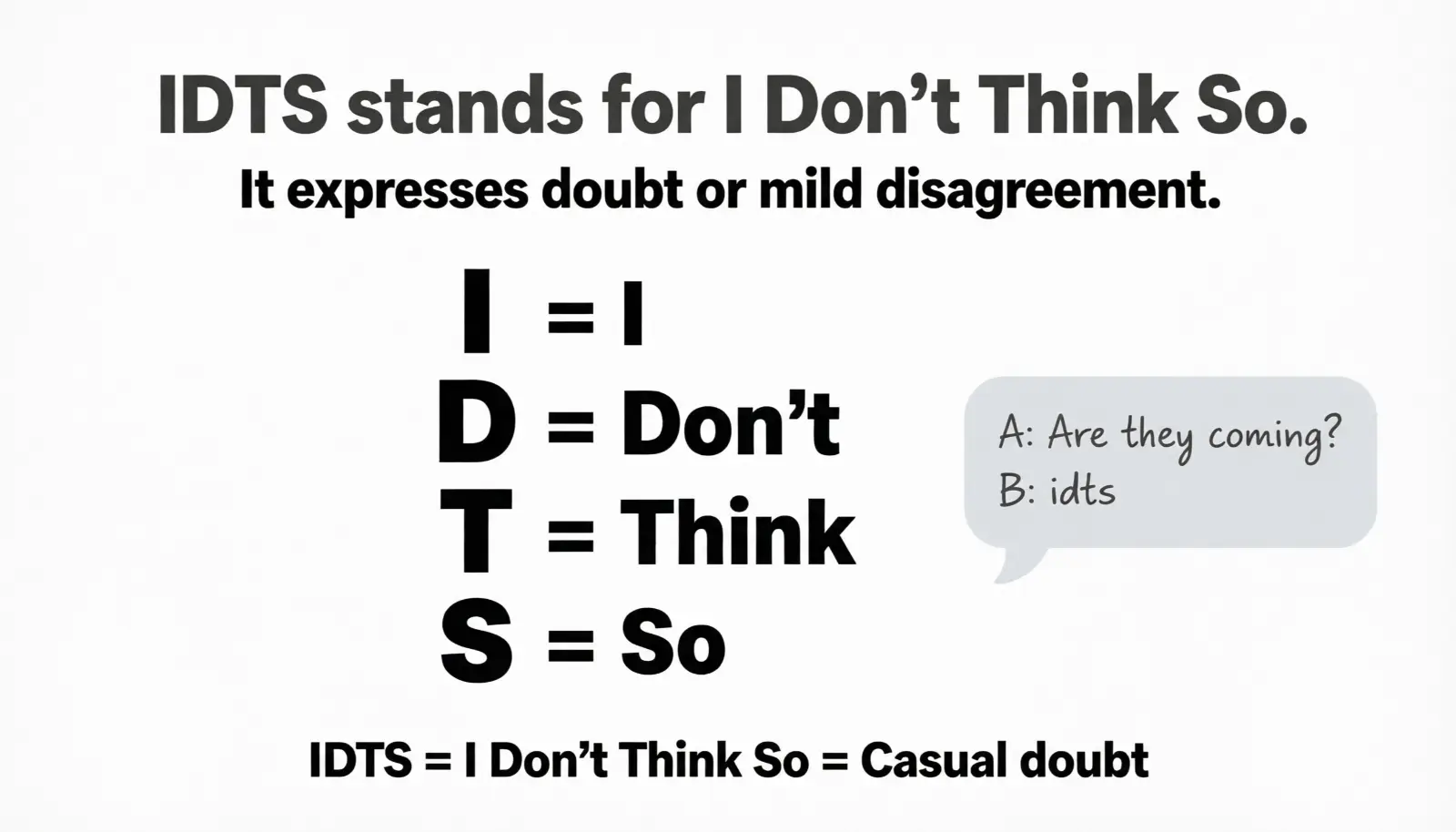
IDTS means “I Don’t Think So.” It’s a casual and slightly dismissive way of saying you disagree, doubt something, or don’t believe it will happen.
But there’s more to it than just the full form. Let’s explore the deeper meaning, tone, psychology, and correct usage of IDTS in text conversations.
🧠 What Does IDTS Mean in Text?
IDTS is the short form of “I Don’t Think So.”
At its core, it expresses:
- Doubt
- Disagreement
- Skepticism
- Mild rejection
It is usually softer than directly saying “No.” However, tone depends heavily on context.
For example:
“Are they giving us extra marks?”
“idts.”
Here, the speaker shows doubt but not anger.
The Tone Behind IDTS
Tone changes based on how it’s written:
- idts → neutral and casual
- idts lol → playful disagreement
- idts 😅 → light and friendly
- IDTS. → can feel firm or blunt
This shows that small additions can change emotional impact.
In short: IDTS = I Don’t Think So = A quick, casual way to express doubt or disagreement.
📱 Where Is IDTS Commonly Used?
IDTS is common in fast digital conversations. It thrives in spaces where speed matters.
🔹 Popular Platforms
- 📱 Text messages
- 💬 WhatsApp chats
- 👻 Snapchat
- 📸 Instagram DMs
- 🎵 TikTok comments
- 🎮 Gaming chats
- 🐦 X (Twitter) replies
🔹 Age Group Usage
It is most popular among:
- Teenagers
- College students
- Young adults
Older generations may prefer the full phrase.
🔹 Formal or Casual?
IDTS is strictly casual.
It is not appropriate in professional settings.
Use it socially. Avoid it formally.
💬 Examples of IDTS in Conversation
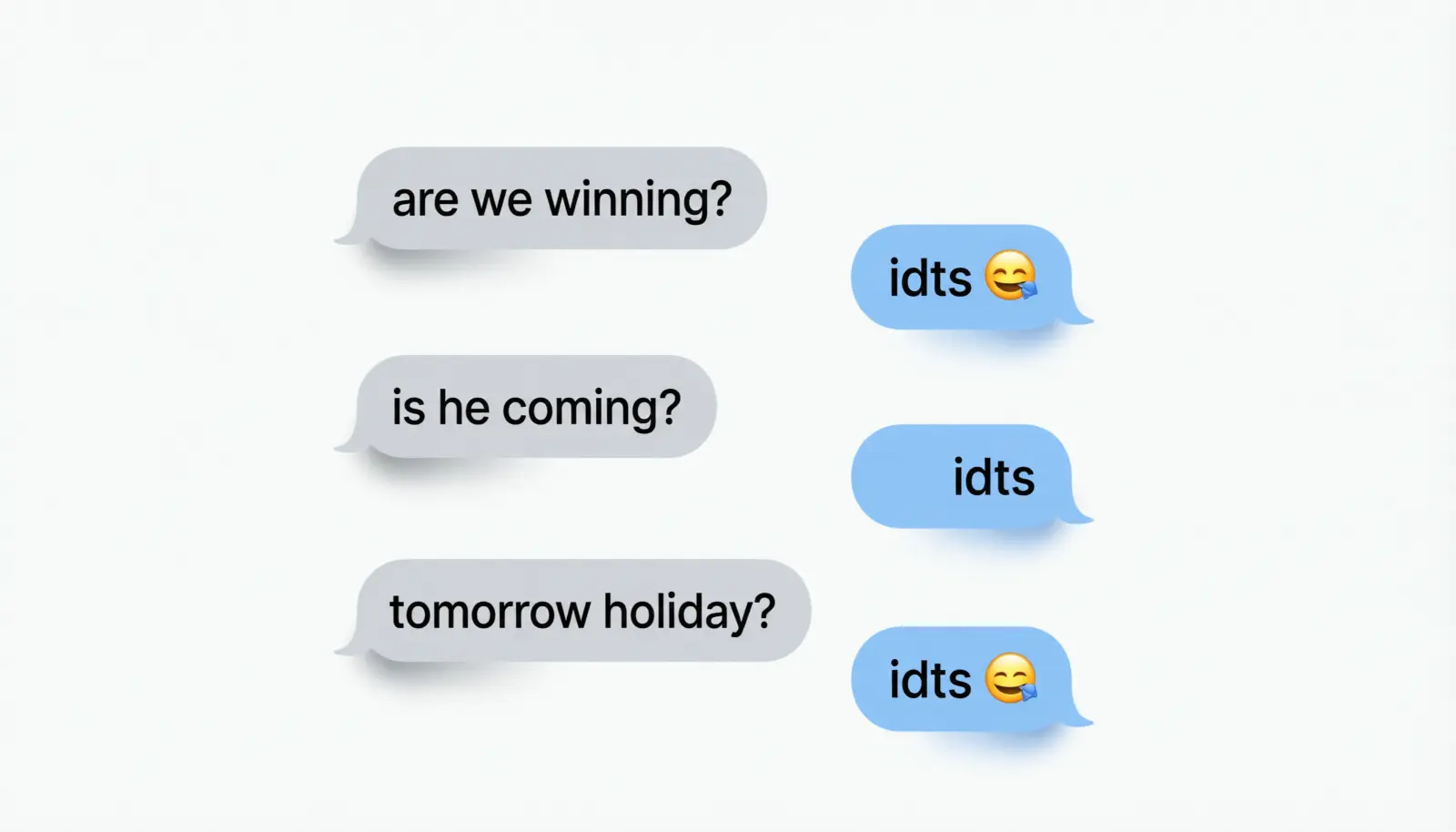
Here are detailed real-life style examples showing different tones:
1️⃣ Casual Doubt
A: are we getting paid today?
B: idts
2️⃣ Playful Disagreement
A: i bet i can beat you in this game
B: idts 😂
3️⃣ Romantic Context
A: do you think he forgot our anniversary?
B: idts… he seemed excited yesterday
4️⃣ Friendly Debate
A: pineapple belongs on pizza
B: idts 😭
5️⃣ Light Rejection
A: should we skip class tomorrow?
B: idts lol
6️⃣ Serious Tone
A: will the project finish by tonight?
B: idts. we still have too much work.
Notice how punctuation changes the mood. Adding explanation makes it softer.
🕓 When to Use and When Not to Use IDTS
Understanding context is very important.
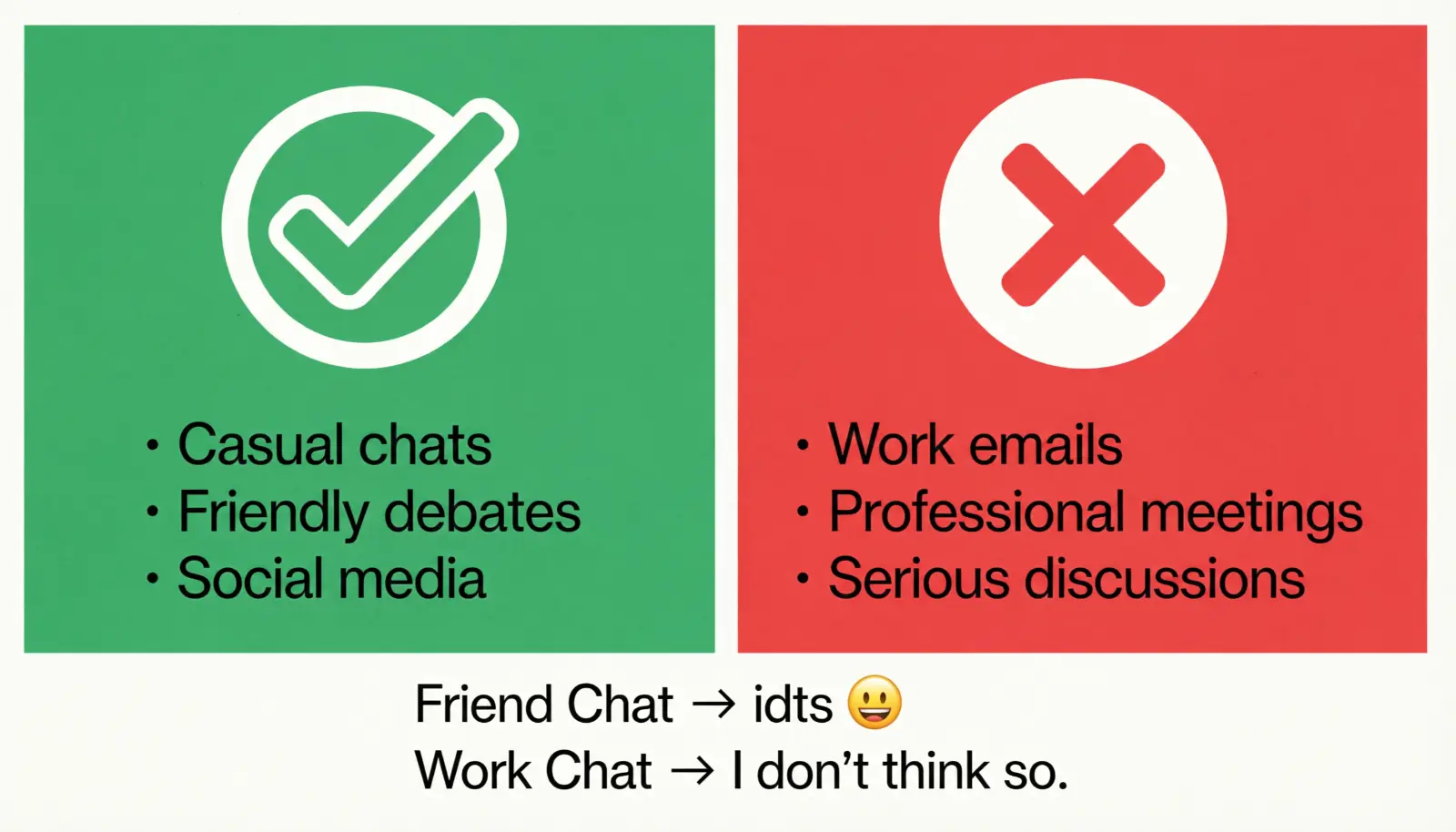
✅ When to Use IDTS
- Casual friend chats
- Playful arguments
- Social media comments
- Gaming banter
- Expressing light doubt
- Friendly teasing
❌ When Not to Use IDTS
- Work emails
- Business meetings
- Academic assignments
- Formal presentations
- Serious emotional discussions
- Customer service replies
Using slang in formal settings can appear unprofessional.
📊 Context Comparison Table
| Context | Example Phrase | Why It Works |
|---|---|---|
| Friend Chat | “idts 😄” | Relaxed & casual |
| Group Chat | “idts, that won’t work” | Clear but informal |
| Work Chat | “I don’t think that will work.” | Professional tone |
| “I do not believe that is feasible.” | Formal & respectful |
Always match language with the situation.
🔎 The Psychology Behind Using IDTS
Short slang like IDTS serves three purposes:
1️⃣ Saves Time
Typing “idts” is faster than typing the full phrase.
2️⃣ Softens Disagreement
It sounds lighter than saying “No.”
3️⃣ Maintains Social Flow
In fast chats, quick replies keep conversations moving.
However, because it is short, it can sometimes feel cold if no emoji or explanation is added.
🔄 Similar Slang Words or Alternatives
Here are similar slang expressions that communicate doubt or opinion:
| Slang | Meaning | When to Use |
|---|---|---|
| IMO | In My Opinion | Sharing views casually |
| TBH | To Be Honest | Being honest in chat |
| IDC | I Don’t Care | Showing indifference |
| NGL | Not Gonna Lie | Admitting truth casually |
| FR | For Real | Emphasizing sincerity |
| SMH | Shaking My Head | Showing disbelief |
These are also informal and suited for texting.
⚠️ Common Misunderstandings About IDTS
❌ Is IDTS Always Negative?
No. It simply shows doubt. Tone determines positivity or negativity.
❌ Is It Aggressive?
Not usually. It can sound blunt without emojis.
❌ Is It the Same as “No”?
Not exactly.
“No” is direct.
“IDTS” suggests uncertainty.
🌍 Is IDTS Popular Worldwide?
Yes, especially in English-speaking countries like:
- United States
- United Kingdom
- Canada
- Australia
It is also spreading globally through social media platforms.
💡 Tips for Using IDTS Correctly
- Add emojis to soften tone.
- Avoid using it in serious situations.
- Consider the relationship with the person.
- Use full form if clarity is important.
- Avoid using it with people unfamiliar with slang.
❓ FAQs About IDTS
1. What is the full form of IDTS?
It stands for I Don’t Think So.
2. Is IDTS formal or informal?
It is completely informal.
3. Can IDTS be flirty?
It can be playful in flirty teasing contexts.
Example:
A: you think you can ignore me?
B: idts 😉
4. Why do people use IDTS instead of the full phrase?
Because it is faster and feels modern.
5. Should I use IDTS in professional emails?
No. Always use the full phrase in professional communication.
📌 Final Thoughts
Understanding the idts meaning in text helps you communicate clearly in modern digital conversations. IDTS stands for “I Don’t Think So,” and it is a casual way to express doubt, disagreement, or mild rejection in chats.
It is quick, simple, and commonly used among friends or on social media. However, tone always depends on context. Adding emojis can make it sound playful. Leaving it plain can make it sound firm.
Remember, idts meaning in text is informal and best suited for relaxed conversations. In professional settings, always use the full phrase instead of the abbreviation.
Now that you know the exact meaning and tone, you can confidently use IDTS the right way in your everyday texting.

I’m Emma Collins, a writer passionate about decoding slang, emojis, and the ever-changing language of the internet. I enjoy turning confusing phrases into clear, easy-to-understand explanations. My mission is to help readers stay in the loop with today’s digital lingo. When I’m not writing, I love exploring social media trends and chatting with friends about new expressions. I’m here to make learning modern language fun and simple!