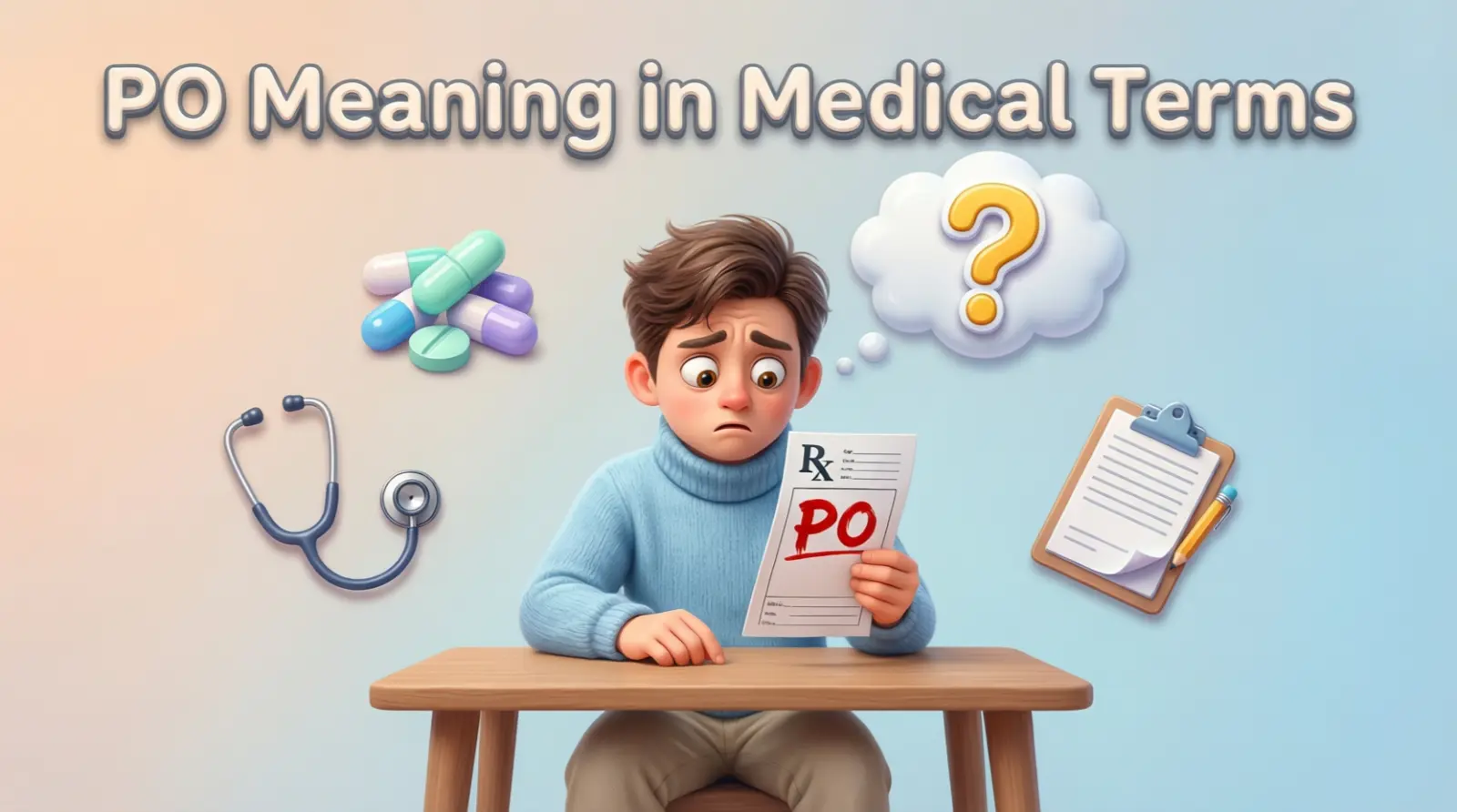
You’re reading a prescription, medical report, or hospital note, and suddenly you see “PO” written next to a medicine name. You pause. PO? Is it a code? A shortcut? A typo?
Don’t worry, you’re not alone. Many people encounter this term for the first time and feel confused, especially if they’re not from a medical background.
Doctors, nurses, and pharmacists use abbreviations all the time to save space and time. PO is one of the most common ones you’ll ever see in healthcare.
Quick Answer:
PO means “per os”, a medical term used to say that medicine should be taken by mouth (orally).
🧠 What Does PO Mean in Medical Terms?
In medical language, PO comes from the Latin phrase “per os”, which literally means “through the mouth.”
When a doctor writes PO on a prescription, they’re instructing that the medication should be swallowed—usually as a tablet, capsule, or liquid.
Simple example:
“Take one tablet PO twice daily.”
This means:
👉 Take one tablet by mouth, two times a day.
In short:
PO = Per Os = Take by mouth (orally)
📱 Where Is PO Commonly Used?
You’ll mostly see PO in professional medical settings rather than casual conversations.
Common places you’ll find PO:
- 🏥 Hospital charts & patient files
- 💊 Prescriptions
- 🩺 Doctor’s notes
- 📄 Medical reports
- 🧪 Clinical instructions
Tone & usage:
- ✔️ Formal
- ✔️ Professional
- ❌ Not used in texting or social media slang
PO is strictly a medical abbreviation, not casual or flirty language.
💬 Examples of PO in Medical Context
Here are realistic examples showing how PO is used in healthcare:
- Doctor’s Order:
“Amoxicillin 500 mg PO every 8 hours.” - Nurse’s Note:
“Patient tolerated fluids PO without nausea.” - Prescription Label:
“Take 1 tablet PO daily with food.” - Hospital Chart:
“Pain medication administered PO.” - Discharge Instructions:
“Continue medications PO as prescribed.”
These examples all show the same thing: the medicine or intake happens by mouth.
🕓 When to Use and When Not to Use PO
✅ When to Use PO
- Writing or reading prescriptions
- Medical documentation
- Healthcare communication
- Clinical instructions
- Nursing or pharmacy contexts
❌ When Not to Use PO
- Casual texting or chatting
- Social media posts
- Non-medical conversations
- Emails to non-medical audiences
- Patient-friendly explanations (without clarification)
Doctors may use PO, but for patients, they usually explain it as “take by mouth.”
Comparison Table
| Context | Example Phrase | Why It Works |
|---|---|---|
| Medical Chart | “Ibuprofen 400 mg PO” | Standard medical shorthand |
| Nurse-to-Nurse | “Patient taking meds PO” | Clear and professional |
| Patient Talk | “Take this by mouth” | Easy to understand |
| “Please take the medication orally” | Formal & clear |
🔄 Similar Medical Terms or Alternatives
Here are related abbreviations you might see alongside PO:
| Slang/Term | Meaning | When to Use |
|---|---|---|
| PO | By mouth | Oral medications |
| IV | Intravenous | Medicine through vein |
| IM | Intramuscular | Injection into muscle |
| SL | Sublingual | Under the tongue |
| PR | Per rectum | Rectal administration |
| Topical | Applied to skin | Creams & ointments |
Knowing these helps you better understand prescriptions and medical notes.
❓ FAQs About PO in Medical Terms
Is PO the same as oral?
Yes. PO simply means oral administration—taking something by mouth.
Is PO used outside medicine?
No. PO is almost exclusively used in medical and healthcare settings.
Can PO mean something else?
In medicine, PO always means “per os.” In other contexts, PO may have different meanings, but not medically.
Why do doctors use PO instead of writing “by mouth”?
It saves time, space, and is universally understood by healthcare professionals.
Is PO safe for everyone?
Not always. Vomiting, surgery, or unconsciousness prevents some patients from taking medications PO, so doctors use other routes instead.
🧾 Final Thoughts
Understanding medical abbreviations can be confusing at first, but PO in medical terms is simple once you know it. PO means “per os,” which tells you that a medication should be taken by mouth (orally). Whether you’re reading a prescription, a doctor’s note, or a hospital chart, recognizing PO helps you follow instructions safely and confidently. Next time you see PO written down, you’ll know exactly what it means and how it applies to taking your medication.

I’m Sara Lexicon, a writer fascinated by words, slang, and how language evolves online. I love turning confusing phrases and trending terms into easy, fun explanations. My goal is to help readers understand and enjoy the language of the digital world. When I’m not decoding words, I’m exploring social media and discovering new ways people express themselves. I’m here to make modern language simple, relatable, and entertaining!