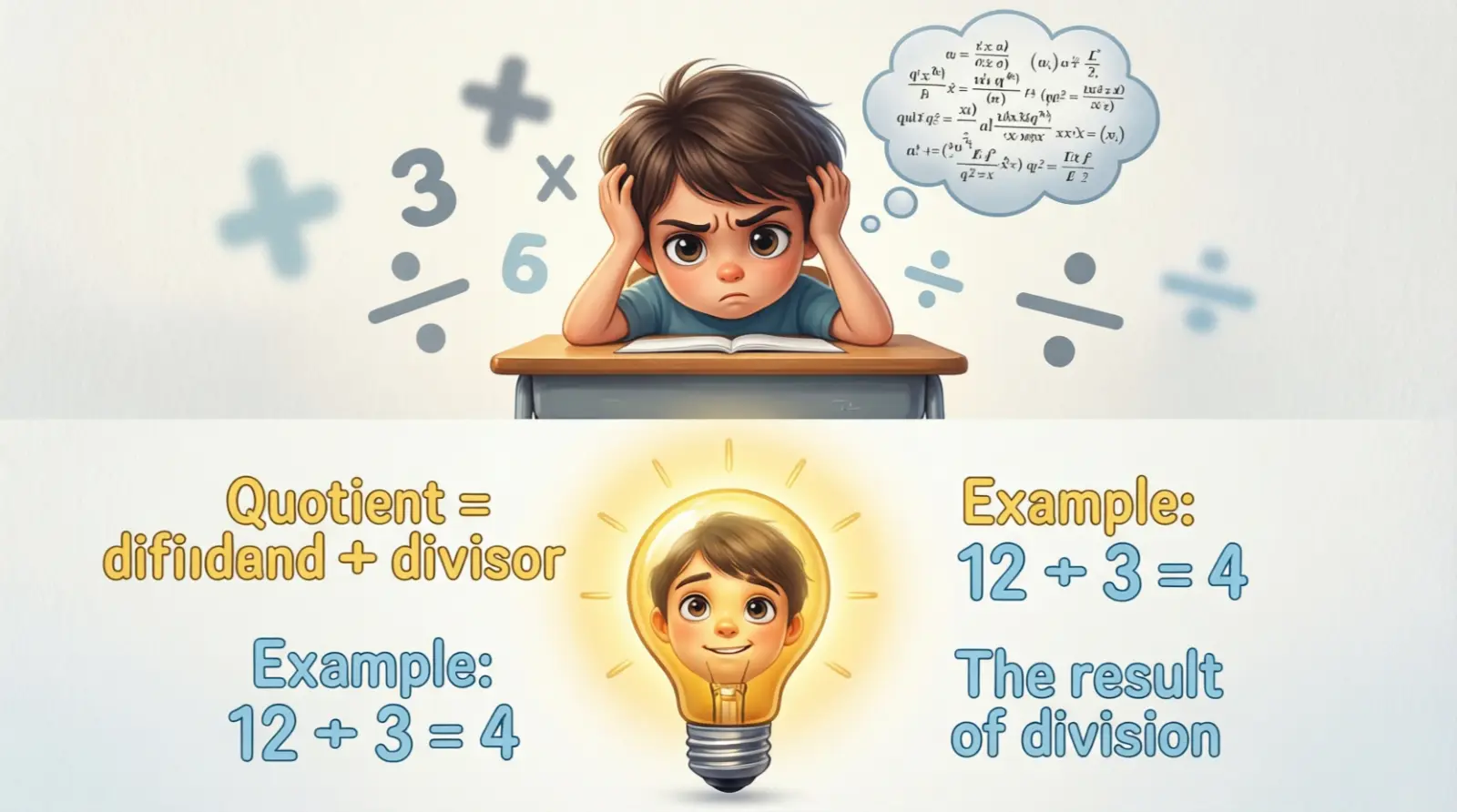
Have you ever been solving a math problem, helping a child with homework, or reading an educational post online when you suddenly came across the word “quotient”?
For a moment, your brain pauses. You kind of remember hearing it in school, but the exact meaning feels a bit fuzzy. 😵💫
That’s a very common experience. Many people know how to divide numbers but don’t always remember the official math terms used to describe the process.
If you’re a student, a parent, or just someone brushing up on basics, understanding what quotient means can make math explanations much clearer.
Quick Answer:
Quotient means the result you get when one number is divided by another. It’s a formal, educational term used to describe the final answer in a division problem.
🧠 What Does Quotient Mean in Text?
The word quotient is a mathematical term used to describe the answer produced by division.
When you divide one number (called the dividend) by another number (called the divisor), the number you end up with is the quotient.
Example:
- 15 ÷ 3 = 5
👉 Here, 5 is the quotient
In simple language, whenever someone says “find the quotient,” they are asking for the division result, not the process.
Example sentence:
“If you divide 48 by 6, the quotient is 8.”
This word helps avoid confusion in math by clearly pointing out which part of the calculation matters most.
In short:
Quotient = result of division = final answer after dividing numbers
📱 Where Is “Quotient” Commonly Used?
Unlike internet slang or abbreviations, quotient is not commonly used in casual texting or social media chats. It belongs mainly to academic and educational settings.
Here’s where you’ll most often see it:
- 📘 School textbooks (math chapters, exercises)
- 🧑🏫 Classroom teaching
- 🧮 Homework and exams
- 💻 Online math tutorials & YouTube lessons
- 📚 Educational blogs and learning apps
- 📝 Competitive exams or worksheets
Tone & Usage Style:
- ✔️ Formal
- ✔️ Educational
- ✔️ Clear and precise
- ❌ Not casual
- ❌ Not slang
- ❌ Not flirty or emotional
If you use the word quotient, people usually assume you’re talking about math.
💬 Examples of Quotient in Conversation
Here are some natural and realistic examples of how “quotient” appears in real conversations, especially related to learning and teaching:
1 Example
A: what’s the quotient of 18 and 3?
B: it’s 6
2 Example
A: my teacher said don’t write the remainder
B: yeah, she only wants the quotient
3 Example
A: is 4 the quotient here?
B: yes, because 20 ÷ 5 = 4
4 Example
A: i keep mixing quotient and remainder 😭
B: quotient is the main answer, remainder is what’s left
5 Example
A: math is confusing today
B: just focus on finding the quotient 😄
6 Example
A: what does quotient even mean
B: it’s just the answer after division
These examples show that while the tone may be casual, the word itself stays academic.
🕓 When to Use and When Not to Use “Quotient”
Understanding context is important. While quotient is a useful word, it doesn’t fit every situation.
✅ When to Use
- Explaining division problems
- Writing math homework or exams
- Teaching students or children
- Creating educational content
- Answering math-related questions
❌ When Not to Use
- Casual chats with friends
- Social media captions
- Emotional conversations
- Non-math topics
- Informal texting
📊 Context Comparison Table
| Context | Example Phrase | Why It Works |
|---|---|---|
| Classroom | “Find the quotient of 36 ÷ 6” | Correct academic usage |
| Homework | “The quotient is 7” | Clear math explanation |
| Friend Chat | “the answer is 7” | Sounds more natural |
| Work Email | “The calculated result is 12” | Professional tone |
| Social Media | “math says the quotient is 9 🤓” | Educational humor |
🔄 Similar Words or Alternatives to “Quotient”
Depending on the situation, you may not always need to say quotient. Here are some alternatives and when to use them:
| Word | Meaning | When to Use |
|---|---|---|
| Answer | Solution | Casual or basic math |
| Result | Final value | General calculations |
| Outcome | End result | Explaining processes |
| Division Result | Result after dividing | Clarifying steps |
| Value | Numerical amount | Technical discussions |
💡 SEO Tip: In non-technical writing, using “answer” instead of “quotient” often feels more natural and user-friendly.
📘 Understanding Quotient With a Simple Breakdown
To understand quotient better, it helps to know the parts of division:
- Dividend → the number being divided
- Divisor → the number you divide by
- Quotient → the result
- Remainder → what’s left (if anything)
Example:
17 ÷ 5 = 3 remainder 2
- Quotient = 3
- Remainder = 2
This breakdown is why teachers often emphasize the word quotient—it helps students focus on the correct part of the answer.
❓ FAQs About Quotient
❓ Is quotient the same as division?
Not exactly. Division is the process, while quotient is the result of that process.
❓ Is quotient used outside math?
Rarely. It’s mostly limited to mathematics and technical fields.
❓ Can a quotient be a decimal?
Yes.
Example: 10 ÷ 4 = 2.5 → the quotient is 2.5
❓ Can a quotient be zero?
Yes.
Example: 0 ÷ 5 = 0 → quotient is 0
❓ Why do teachers use the word quotient?
Because it helps students clearly identify which part of division they are solving for.
❓ Is quotient important for exams?
Absolutely. Many exam questions specifically ask for the quotient, not the remainder.
Final Thoughts
To wrap it up, what does quotient mean is actually very simple once you break it down. A quotient is the result or answer you get when one number is divided by another. It’s a formal math term that helps clearly describe division, especially in school, exams, and educational explanations.
While you won’t usually see quotient used as slang in texting or social media, it plays an important role in understanding and communicating math problems correctly. If someone asks for the quotient, they’re not asking for the steps—just the final division answer.
In short:
👉 Quotient = the answer after division
Knowing this meaning makes math easier, clearer, and far less confusing the next time the word pops up. 😊

I’m Emma Collins, a writer passionate about decoding slang, emojis, and the ever-changing language of the internet. I enjoy turning confusing phrases into clear, easy-to-understand explanations. My mission is to help readers stay in the loop with today’s digital lingo. When I’m not writing, I love exploring social media trends and chatting with friends about new expressions. I’m here to make learning modern language fun and simple!