Have you ever been scrolling through your messages and suddenly saw SM pop up, leaving you scratching your head?
You’re not alone! Text slang can be confusing, especially when abbreviations are short and not widely known.
If it was from a friend, a social media comment, or a chat group, seeing SM might make you wonder if it’s a typo, a secret code, or something playful.
Quick Answer:
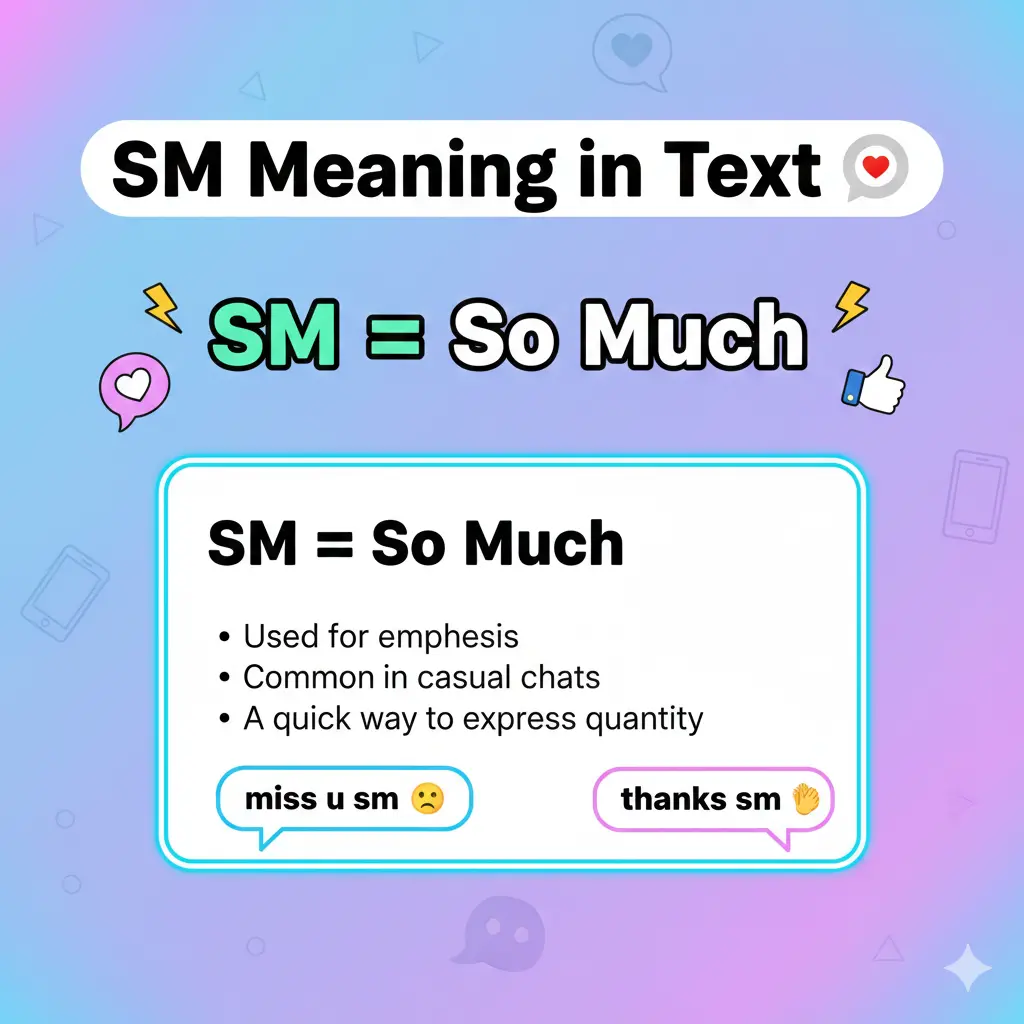
SM in text messages usually means “So Much” or “Social Media”, depending on the context. It’s a casual, friendly way to express emphasis or refer to online platforms. Knowing how to use it can make your texting smoother and more relatable.
What Does SM Mean in Text?
In everyday texting and social media conversations, SM stands for “so much.”
It’s used to intensify feelings or add emotional weight to a message. People use it when they want to express something strongly without typing a long sentence.
✔ How it’s used:
- To show appreciation
- To express affection
- To emphasize excitement
- To add emotional tone
- To dramatize feelings (positive or negative)
Examples:
- “thanks sm for helping me today ❤️”
- “i love this show sm omg 😭”
- “that hurt sm bro 😭💀”
In short: SM = So Much = A fast and emotional way to add emphasis.

Where Is SM Commonly Used?
“sm” appears naturally in platforms where short, fast communication is the norm. Because it’s such a quick abbreviation, it fits perfectly into modern digital conversations.
Most common places you’ll see “sm”:
- 📱 Text messages – especially between close friends
- 💬 Snapchat chats – extremely popular among teens
- 📸 Instagram stories & DMs
- 🎵 TikTok comments – often used with emotional reactions
- 🎮 Gaming chats – for quick communication
- 🧡 Twitter/X – people use it for emphasis in short posts
- 😄 Group chats – family, friends, classmates
Tone of the slang:
- Very casual
- Often emotional or sentimental
- Not suitable for professional or formal messages
- Ideal for friendly, humorous, romantic, or expressive conversations
If you’re sending a quick, heartfelt, or dramatic text, “sm” fits perfectly.

Examples of SM in Conversation
Here are 7 natural, realistic chat examples to show how “sm” is commonly used:
1.
A: u helped me so much today
B: ofc!! love u sm 🥺💗
2.
A: this burger hits sm omg
B: RIGHT?? best thing ever 😂
3.
A: i’m stressed
B: same sm, school is killing me 😭
4.
A: thank u for being there
B: appreciate u sm fr
5.
A: i miss u
B: miss u sm too 😞💛
6.
A: this new song slaps so hard
B: i love it sm i’ve been looping it all day
7.
A: sorry if i was annoying
B: bro not at all, i like talking to u sm
These examples show how “sm” adds emotion without needing long explanations.

When to Use and When Not to Use SM
Even though “sm” is extremely common, it’s not appropriate in all situations. Here’s how to use it correctly:
✅ Use “sm” when:
- Texting friends
- Chatting with your crush
- Sharing emotional messages
- Commenting on social media posts
- Expressing gratitude casually
- Showing affection without overthinking
- Adding drama or excitement
❌ Avoid “sm” when:
- Writing school assignments
- Talking to teachers or professors
- Messaging your boss or colleagues
- Sending client or business emails
- Talking about serious or sensitive issues
- Communicating in formal environments
Using “sm” in the wrong place can make you sound unprofessional or immature.
Context Comparison Table
| Context | Example Phrase | Why It Works |
|---|---|---|
| Friend Chat | “thanks sm 😄” | Casual tone fits perfectly |
| Romantic Chat | “i miss you sm 🥺” | Soft, emotional, flirty |
| Sibling/Family | “love you sm bro” | Warm & affectionate |
| Work Chat | “Thank you so much for the update.” | Clear & professional |
| Professional Email | “Please take your time to review this.” | Formal & respectful |
| Teacher/Student | “I appreciate your guidance.” | Proper for education settings |

Similar Slang Words or Alternatives
If you want to express the same emotion as “sm,” here are some common alternatives people use in texting:
| Slang/Word | Meaning | When to Use |
|---|---|---|
| ily | I love you | Close friends or romantic chats |
| ilysm | I love you so much | Strong emotional tone |
| tysm | Thank you so much | Gratitude-heavy messages |
| fr | For real | Agreeing strongly |
| soooo | Emphasized “so” | Dramatic or excited tone |
| deadass | Seriously | Strong emphasis in casual chats |
These alternatives help add emotion or emphasis depending on the context.
FAQs About SM
1. What does “sm” usually mean in texting?
It almost always means “so much.” This is the default meaning in texting, Instagram, Snapchat, TikTok, and group chats.
2. Is SM the same as S&M?
No.
S&M refers to something entirely different in adult contexts.
In texting, “sm” simply means “so much.”
3. Can “sm” be flirty?
Yes — depending on the context. Messages like “i miss u sm” or “i like u sm” can definitely sound flirty, emotional, or affectionate.
4. Do adults use SM or just teens?
Mostly Gen-Z, but it’s becoming common among millennials too. Adults tend to type the full phrase “so much” instead of the abbreviation.
5. Can SM be used negatively?
Yes. It can also emphasize negative emotions:
“that hurt sm”
“i’m struggling sm today.”
6. Should I write it in uppercase?
You can, but most people write it lowercase (“sm”) because it feels more natural in texting.
7. Is SM formal?
Not at all. It should never be used in professional communication.
Final Thoughts
“SM” is one of those short, simple slang terms that can add a lot of emotion to your messages. Whether you’re telling someone you appreciate them, expressing excitement, or adding dramatic emphasis, this tiny abbreviation helps you communicate feelings quickly and naturally.
As long as you use it in the right setting — friendly, casual, or social-media chats — it’s a great tool for making your conversations feel more expressive and human.
So the next time someone texts you “i miss u sm” or “thanks sm,” you’ll know exactly what they mean — and you might even start using it sm too. 😄💬

- I’m Casey Morgan, a writer who loves breaking down internet slang and modern lingo into simple, relatable explanations. I’ve spent years studying how digital communication shapes the way we talk. My goal is to make every confusing phrase easy to understand. When I’m not decoding trends, you’ll find me sipping coffee and browsing social media for the next viral term.