Have you ever been scrolling through an article, reading a school assignment, or checking a long explanation online when you suddenly came across the word “synthesize” and paused for a second? 😅
Maybe you thought, “Is this some scientific word?” or “Does this mean summarize?” You’re definitely not alone.
Many people first see synthesize in essays, textbooks, blog posts, or even professional emails, and it can feel confusing because it sounds technical or advanced.
But once you understand it, you’ll realize it’s actually a very practical and everyday word, especially in learning and communication.
Quick Answer:
Synthesize means to combine different pieces of information or ideas into one clear and meaningful whole. It’s a neutral and informative word often used when explaining, summarizing, or making sense of information in text, writing, or conversation.
🧠 What Does Synthesize Mean in Text?
In text and writing, synthesize means bringing multiple ideas together and explaining them in a clear, unified way. Instead of repeating information word-for-word, you understand it and then present it in your own words.
Think of it like this:
- You read several sources
- You understand the main points
- You combine them into one explanation
That process is called synthesizing.
Simple example sentence:
“Please synthesize the information from all three articles.”
This means: read everything, understand it, and combine the ideas into one clear explanation.
Another easy example:
“She synthesized the comments and wrote a helpful summary.”
Bold takeaway:
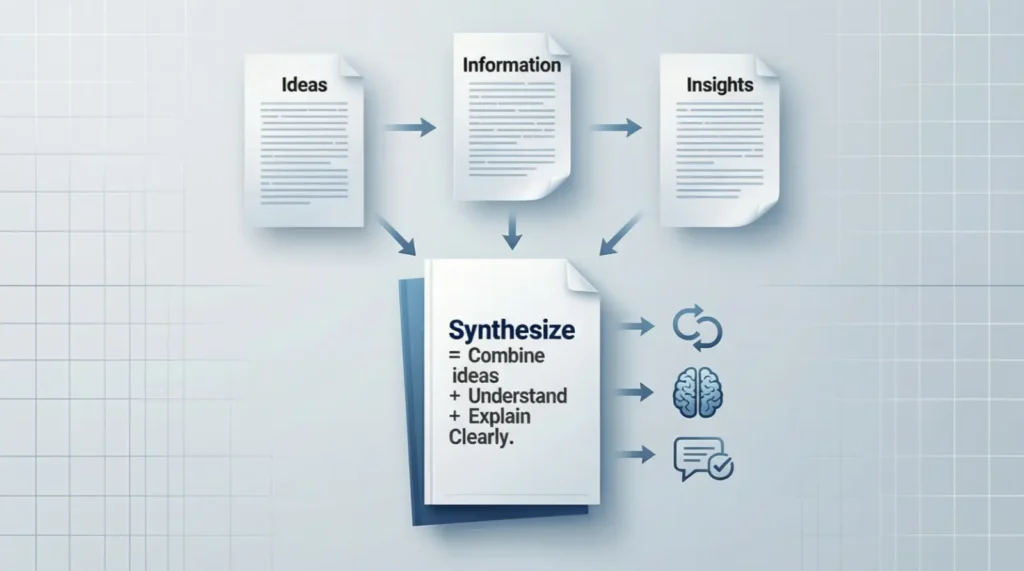
In short:
Synthesize = Combine ideas + Understand them + Explain clearly
📱 Where Is “Synthesize” Commonly Used?
Unlike popular text slang, synthesize is not casual internet slang. However, it’s very common in digital communication where explanation is needed.
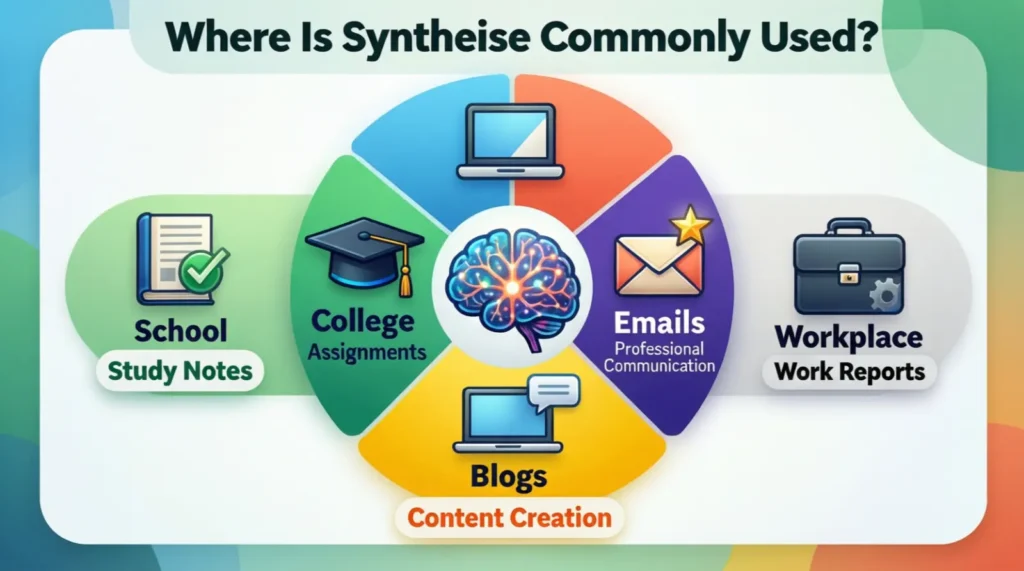
You’ll often see “synthesize” used on:
- 📚 School & college assignments
- 🧑💻 Educational blogs & articles
- 🧠 Study guides and notes
- 💼 Workplace documents & reports
- 📩 Professional emails
- 🧪 Science and research content
Tone & usage style:
- ❌ Not flirty
- ❌ Not playful slang
- ✅ Educational
- ✅ Neutral to formal
- ✅ Professional and academic
👉 If someone uses “synthesize,” they usually want clarity, not casual chat.
💬 Examples of “Synthesize” in Conversation
Here are realistic, natural examples showing how people use synthesize in text-based conversations:
1 Example
A: did you read all the sources?
B: yeah, now i’ll synthesize them into one answer
2 Example
A: this topic feels overwhelming
B: just synthesize the key ideas, it’ll make sense 🙂
3 Example
A: what does the teacher expect?
B: she wants us to synthesize the chapters in our own words
4 Example
A: your explanation was really clear
B: thanks! i tried to synthesize everything simply
5 Example
A: can you make this shorter and clearer?
B: sure, i’ll synthesize it ✍️
6 Example
A: how do i study for this test?
B: read everything, then synthesize the concepts
7 Example
A: why is your report so easy to read?
B: because i synthesized all the data first 😄
🕓 When to Use and When Not to Use “Synthesize”
Knowing when to use this word makes your communication sound natural and confident.
✅ When to Use “Synthesize”
- Writing essays or assignments
- Explaining information clearly
- Summarizing multiple sources
- Academic discussions
- Professional emails or reports
- Research-based content
❌ When Not to Use “Synthesize”
- Casual texting with friends
- Emotional or personal chats
- Jokes, memes, or slang-heavy messages
- Urgent or time-sensitive texts
Comparison Table
| Context | Example Phrase | Why It Works |
|---|---|---|
| Friend Chat | “I’ll explain it simply” | Sounds natural |
| Study Group | “Let’s synthesize the readings” | Academic & clear |
| Work Chat | “Please synthesize the findings” | Professional |
| “Kindly synthesize the information provided” | Formal & polite |
🔄 Similar Words or Alternatives to “Synthesize”
If synthesize feels too formal, here are easy alternatives you can use depending on the situation:
| Word | Meaning | When to Use |
|---|---|---|
| Summarize | Shorten main points | Notes & quick reviews |
| Combine | Put ideas together | Casual explanations |
| Integrate | Blend smoothly | Professional writing |
| Condense | Make shorter | Editing content |
| Explain | Make clear | Everyday conversation |
| Break down | Simplify information | Teaching or helping |
👉 Tip: In casual texting, “sum up” or “explain” sounds more natural than synthesize.
❓ FAQs About “Synthesize”
❓ Is “synthesize” a slang word?
No. Synthesize is not slang. It’s a proper English word used in academic, professional, and informational contexts.
❓ Can “synthesize” be used in texting?
Yes, but it may sound formal. In casual chats, people usually prefer “sum it up” or “explain it.”
❓ Is synthesize the same as summarize?
Not exactly.
- Summarize = make information shorter
- Synthesize = combine ideas and explain them clearly
❓ Is “synthesize” used in science?
Yes. In science, synthesize often means creating something new, such as synthesizing chemicals or compounds.
❓ Is it okay to use “synthesize” in essays?
Absolutely. Teachers and professors often expect students to synthesize information rather than copy it.
❓ Does synthesize mean copying?
No. Synthesizing means understanding and rephrasing, not copying text.
🔍 Final Thoughts
Understanding what does synthesize mean can make a big difference in how you communicate, study, or write. Synthesize means to combine different ideas, information, or parts into one clear and meaningful whole. By learning to synthesize information, you’re not just summarizing—you’re actively understanding, connecting, and presenting ideas in a clear way.
Whether you’re working on a school assignment, writing a blog, or explaining something at work, knowing how to synthesize helps you make your messages clearer, more organized, and easier to understand. Next time you see the word, remember: to synthesize is to combine and clarify ideas. Using it correctly can instantly make your writing and explanations more professional and effective.

I’m Emma Collins, a writer passionate about decoding slang, emojis, and the ever-changing language of the internet. I enjoy turning confusing phrases into clear, easy-to-understand explanations. My mission is to help readers stay in the loop with today’s digital lingo. When I’m not writing, I love exploring social media trends and chatting with friends about new expressions. I’m here to make learning modern language fun and simple!