The first time I saw “TBU” in a message, I honestly thought it was a typo. It popped up under an event post.
There was a date, but the location said “TBU.” I kept rereading it, trying to guess the meaning.
Was it a place? A code? A mistake? If you’ve had the same confusion, you’re not alone.
Text slang evolves fast. New abbreviations appear daily across social media. Understanding them helps you stay confident in conversations.
Quick Answer:
TBU means “To Be Updated.” It’s a neutral and informative way of saying more details will be added later.
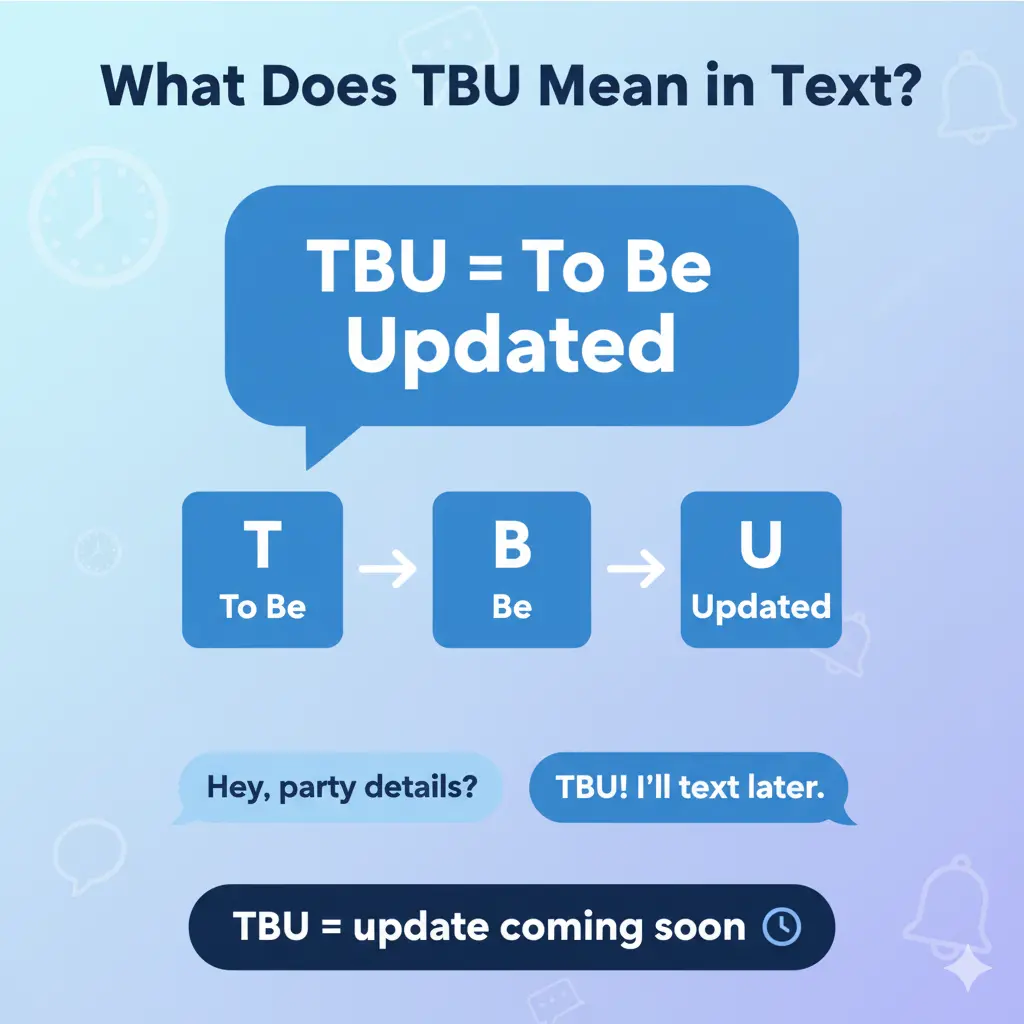
What Does TBU Mean in Text?
TBU = To Be Updated.
People use the abbreviation when they have not confirmed something yet and plan to share new information later. It helps keep conversations quick and clear, especially when timing, plans, or decisions are still pending.
People often use TBU in situations like:
- Sharing event details
- Discussing upcoming plans
- Talking about schedules
- Providing project updates
- Announcing something that is still being prepared
Example sentence:
“The exact date is TBU—we’re waiting for final approval.”
The phrase shows that the final answer isn’t available yet, but an update will come.
In short:
TBU = To Be Updated = Someone will update you soon.
📚 The Deeper Meaning Behind TBU
TBU is about temporary incompleteness.
It shows three things:
- The topic is active.
- A decision or confirmation is pending.
- An update is expected.
Unlike some slang that expresses emotion, TBU is practical.
It carries no strong emotional tone.
TBU is neutral and informational.
It is often used in:
- Event planning
- Online announcements
- Project updates
- Social media captions
- Gaming tournaments
- Group chats
Because it is short, it saves space and time.
That is why it works well in fast digital communication.
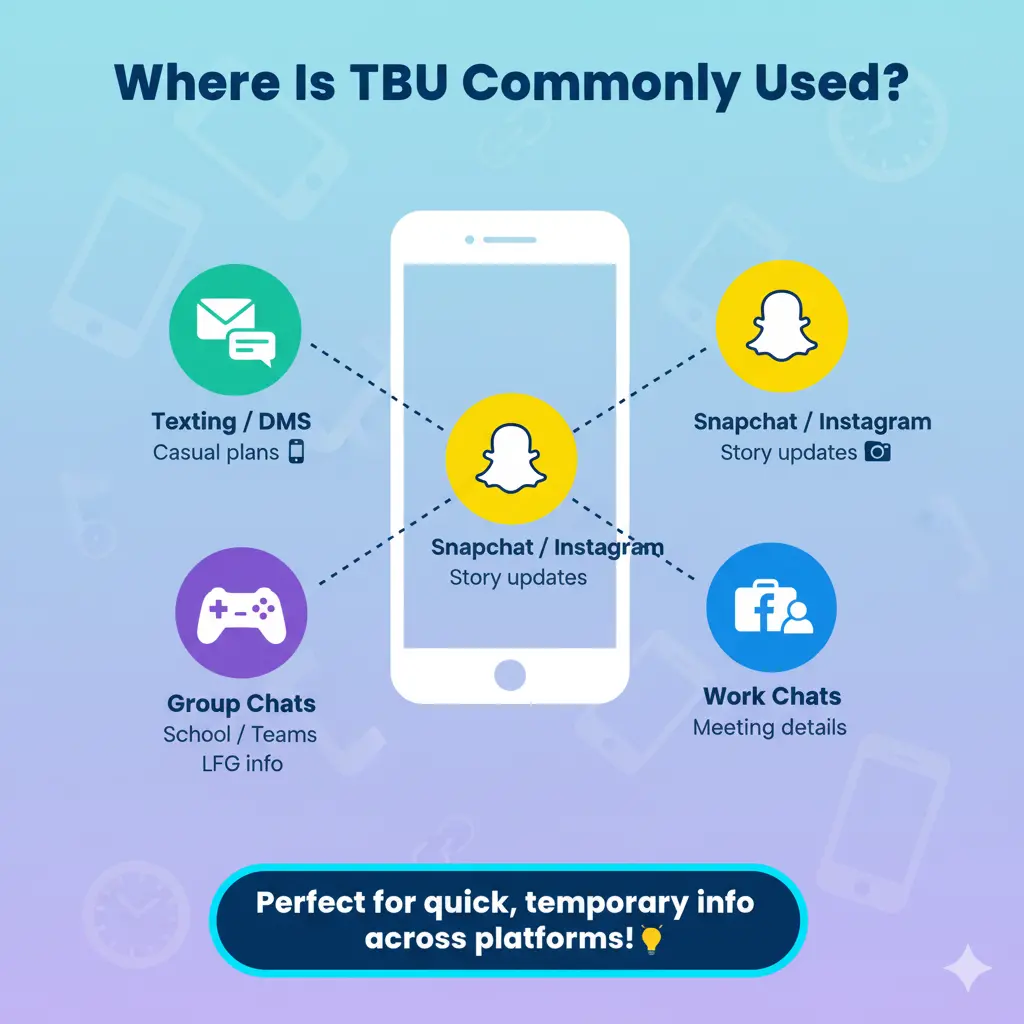
Where Is TBU Commonly Used?
TBU appears across a variety of online platforms and chats. Its simplicity makes it flexible for casual and semi-formal use.
📱 Most common places you’ll see TBU:
- 💬 Text messages / SMS — quick updates between friends
- 💻 Work chats (Slack, Teams) — internal status updates
- 📘 Facebook posts & groups — event announcements
- 📷 Instagram stories/captions — upcoming releases
- 🧵 Twitter/X — creators or brands sharing pending info
- 📚 School or project groups — schedule or assignment updates
- 🎮 Gaming chats — tournament or match timings
✨ Tone & vibe of TBU:
- Neutral
- Informative
- Not flirty
- Not emotional
- Polite, but not formal
This makes it perfect for everyday chats, planning groups, or collaborative work.
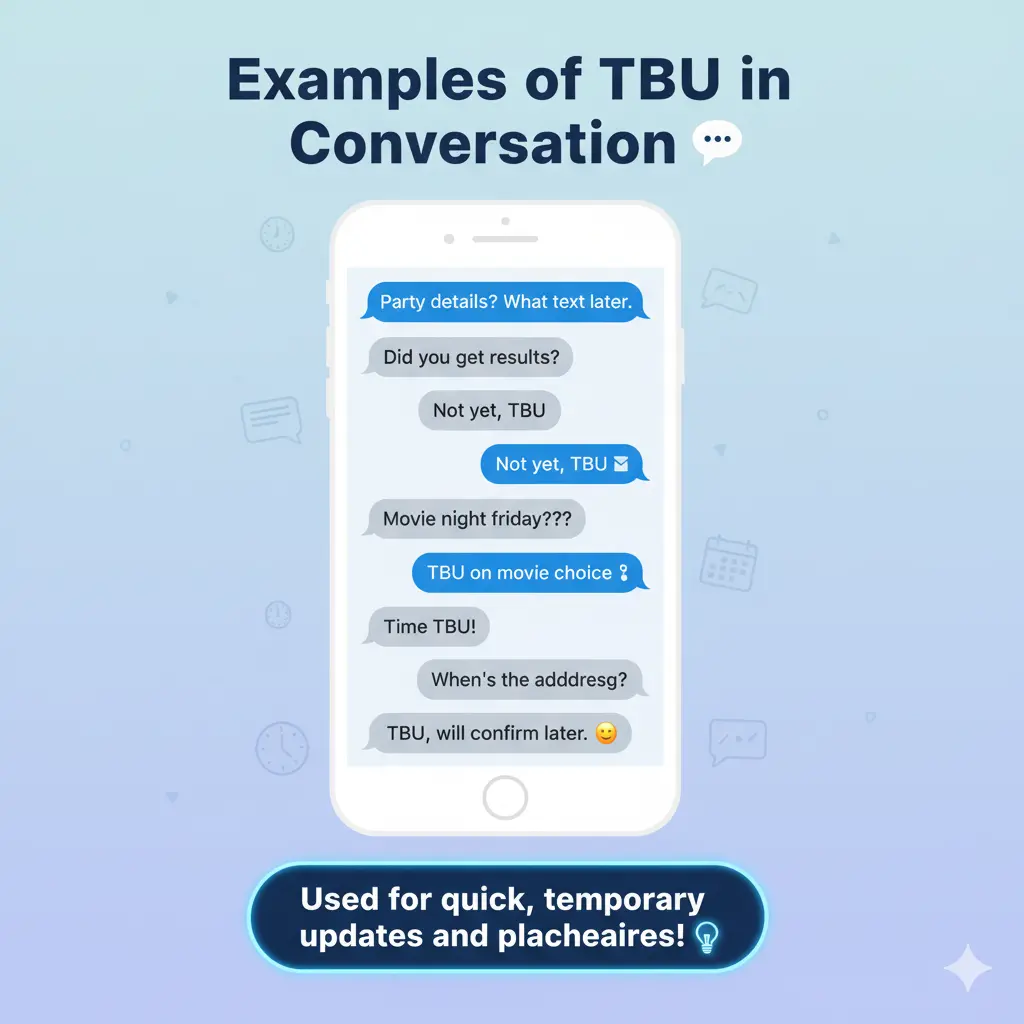
Examples of TBU in Conversation
Here are realistic, natural chat examples:
1️⃣ Friends Planning a Trip
A: what’s the hotel name?
B: still tbu, we’re comparing prices 😅
2️⃣ Birthday Party Post
A: party this friday 🎉 location tbu
B: omg I’m coming!!
3️⃣ Group Project
A: when are we submitting?
B: final deadline tbu. teacher deciding.
4️⃣ Gaming Tournament
A: bracket released yet?
B: no, match order tbu 🎮
5️⃣ Workplace Chat (Informal Team)
A: client confirmed the timeline?
B: not fully. delivery date is tbu.
6️⃣ Fashion Post
A: where did you get that dress?
B: brand name tbu. I’ll check the tag.
Notice how short and functional it is.
It prevents long explanations.
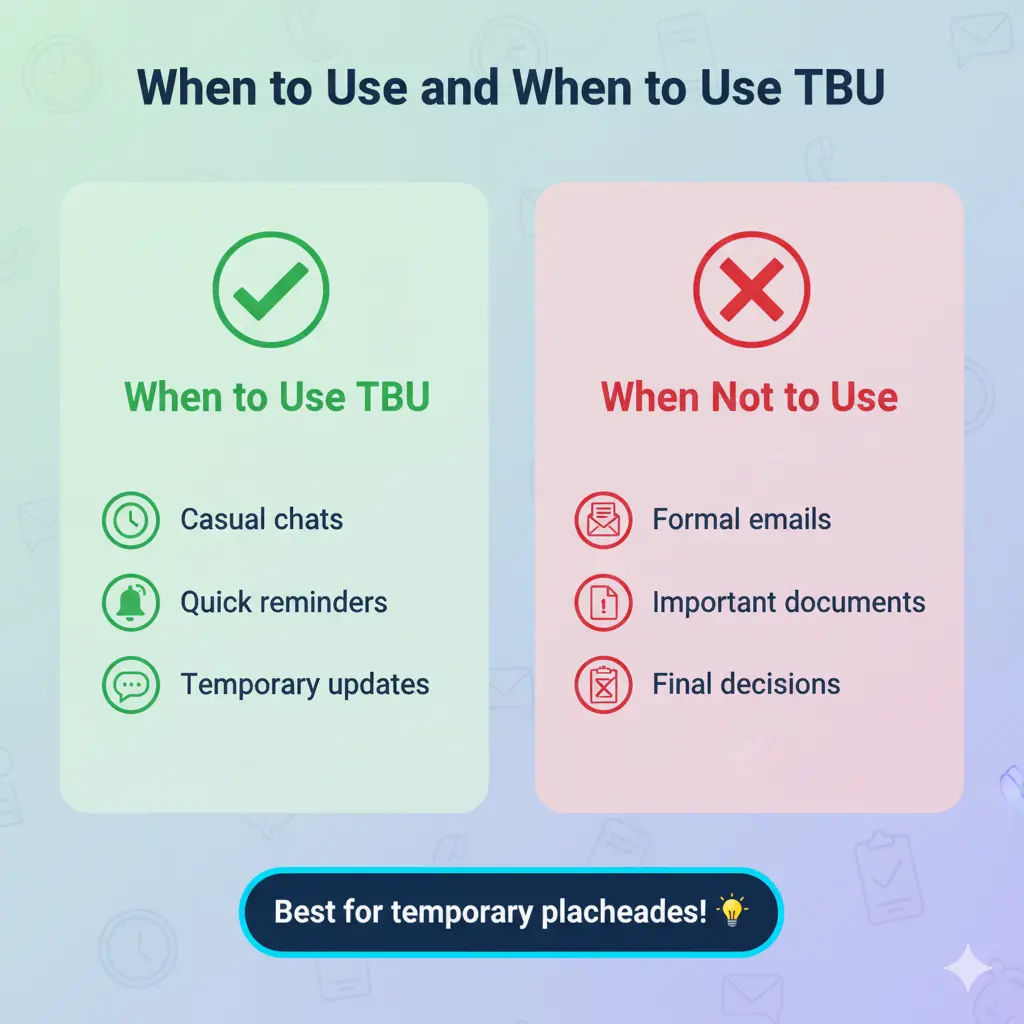
When to Use and When Not to Use TBU
Using TBU correctly makes communication smoother. Here’s how to decide when it fits.
✅ Use TBU When:
- You don’t have final information yet
- You want to keep the conversation informal but clear
- You’re giving a status update
- You’re talking in a group chat
- You want to save time by typing a short form
- You’re managing schedules or plans
- You want to say “I’ll update you soon” without sounding formal
❌ Do NOT Use TBU When:
- You’re writing a formal email
- You’re speaking to someone unfamiliar with internet slang
- The situation is urgent or needs full clarity
- You’re communicating with clients or superiors
- The update involves important or legal information
- You want a professional tone
Using slang in serious or formal communication can make you appear careless or unprofessional. Always use the full phrase instead. Write, “We will update this soon.”
Comparison Table: TBU Usage in Different Contexts
| Context | Example Phrase | Why It Works |
|---|---|---|
| Friend Chat | “Meeting spot TBU 😄” | Friendly & casual |
| Gaming Chat | “Match timing TBU until further notice” | Quick & clear |
| Group Project | “Slide order is TBU” | Informative & neutral |
| Work Chat | “Client approval TBU” | Semi-professional & concise |
| Professional Email | “The schedule will be updated shortly.” | Formal, respectful |
| Announcement | “Event details TBU—stay tuned!” | Good for audiences |
Similar Slang Words or Alternatives
Here are slang abbreviations and phrases people use instead of TBU:
| Slang/Term | Meaning | Best Use Case |
|---|---|---|
| TBA | To Be Announced | When the announcement is coming later |
| TBD | To Be Decided | When the decision isn’t made yet |
| TBH | To Be Honest | When expressing an opinion |
| FYI | For Your Information | Sharing details or updates |
| BRB | Be Right Back | Stepping away briefly |
| LMK | Let Me Know | Asking for an update |
🧠 Tone and Social Meaning of TBU
TBU is emotionally neutral. It does not express excitement or disappointment.
It simply communicates status. However, tone depends on context.
“Party details TBU 👀” can sound exciting.
“Budget approval TBU” can sound cautious.
The abbreviation adapts to the mood of the message.
It is not flirty.
TBU is not rude.
It is not aggressive.
It is purely informational.
🌎 Is TBU Popular Worldwide?
Yes, especially in English-speaking online communities. It is widely used in the US, UK, Canada, and Australia. It is also common in countries where English is used online. In regions like Pakistan and India, young users also adopt it in social media chats. Because it is simple English, it spreads easily across platforms.
FAQs About TBU
1. Is TBU the same as TBA?
No.
- TBU = To Be Updated → future update coming
- TBA = To Be Announced → official announcement pending
2. Is TBU appropriate for work?
Yes—but only in quick internal chats. Avoid using it in official emails or documents.
3. Is TBU formal or informal?
TBU is informal to semi-formal, depending on the context.
4. Is TBU used globally?
Yes. It’s widely used across the U.S., U.K., and most English-speaking online communities.
5. Does TBU have any flirty meaning?
Not at all. It’s strictly informational with no emotional or romantic tone.
6. Can TBU be used in social media captions?
Definitely! It works well for creators teasing upcoming posts or releases.
7. Is TBU the same as TBD?
No.
- TBU = update pending
- TBD = decision pending
8. What’s the full form of TBU in texting?
The full form is To Be Updated.
9. What does it mean if someone replies with “TBU”?
It means they will update you later because the info is not final yet.
10. Is TBU outdated?
Not at all—it’s actively used in group chats, planning messages, and updates.
Final Thoughts
Understanding TBU meaning in text makes online conversations much easier to follow.
TBU stands for “To Be Updated.” It simply means that more information will be shared later. This abbreviation is practical and time-saving. It helps people communicate incomplete details quickly. You will often see it in event planning, group chats, and social media captions. TBU is neutral in tone. It is neither emotional nor dramatic. It is clear, short, and direct. However, it works best in casual or semi-formal settings. In professional emails, writing the full phrase is safer. Now that you know TBU meaning in text = To Be Updated, you can confidently use it in your digital conversations. No confusion. No guessing.
Just clear communication.

I’m Emma Collins, a writer passionate about decoding slang, emojis, and the ever-changing language of the internet. I enjoy turning confusing phrases into clear, easy-to-understand explanations. My mission is to help readers stay in the loop with today’s digital lingo. When I’m not writing, I love exploring social media trends and chatting with friends about new expressions. I’m here to make learning modern language fun and simple!